

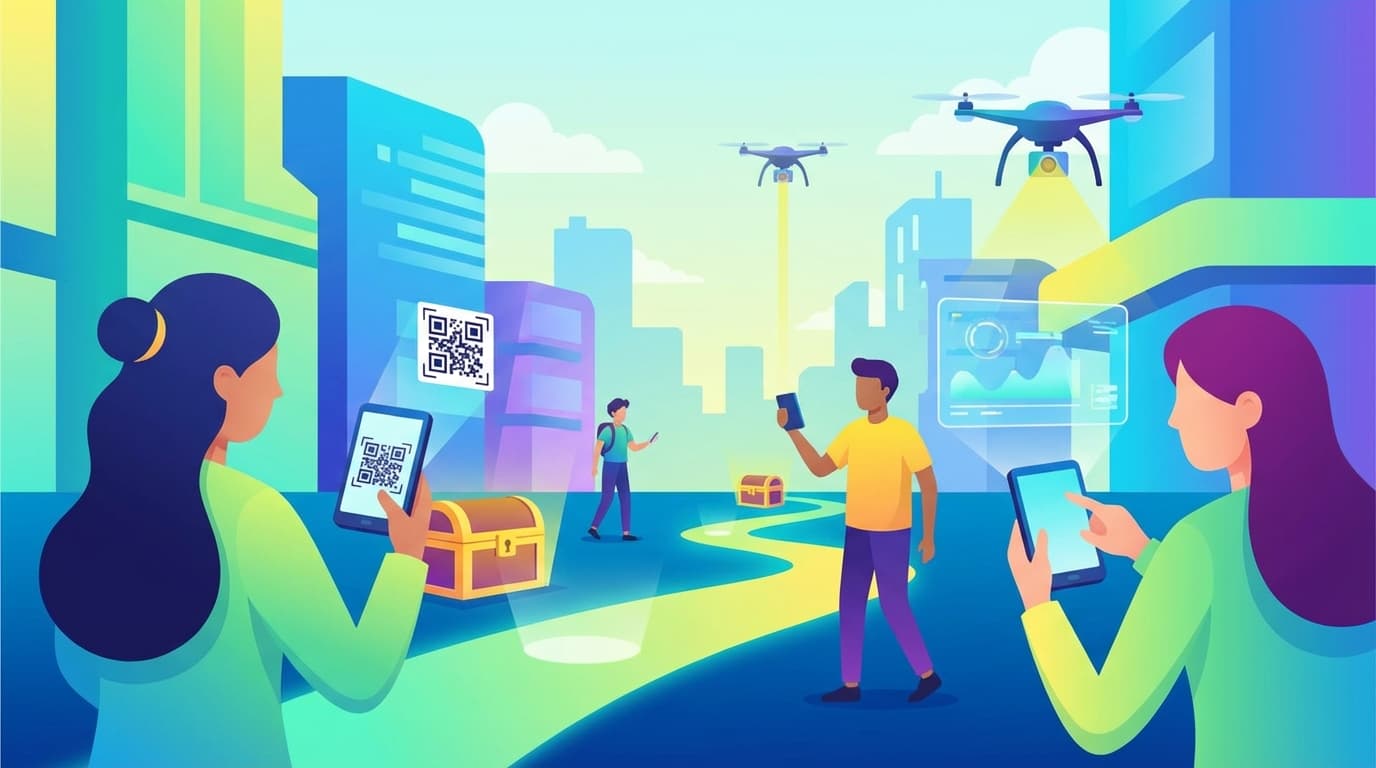
QR Code Treasure Hunts Revolutionize Games in 2025
Picture this: you're standing in front of a bronze statue in lower Manhattan, pointing your phone at a small black-and-white square. Suddenly, Alexander Hamilton materializes on your screen, reciting a riddle that leads you to your next clue twelve blocks away. A year ago, this would have sounded like science fiction. In 2025, it's a Tuesday afternoon.
QR code treasure hunts have broken free from their niche origins. What started as a novelty for tech-savvy early adopters has become a mainstream phenomenon reshaping how we approach interactive games, corporate engagement, tourism, and education. With over 2.9 billion people worldwide expected to use QR codes by 2025, according to barkoder.com and openqr.io, that humble black-and-white square now serves as a gateway to immersive experiences that blur the boundary between physical and digital worlds. Citywide scavenger hunts celebrating Broadway milestones. Corporate team-building exercises that outperform traditional methods by wide margins. Educational quests that turn reluctant students into eager explorers.
This isn't a gimmick anymore. It's a full-blown movement. But like any movement, it comes with complications: emerging security threats, persistent accessibility questions, and technology evolving so fast it's hard to keep up. Here's a thorough look at how QR code treasure hunts are transforming interactive games in 2025, and what that means for businesses, event organizers, educators, and players.
The Rise of "Phygital" Gaming Experiences
If one word captures what QR code treasure hunts have become in 2025, it's "phygital": the seamless fusion of physical and digital experiences. Scanning a QR code used to mean landing on a static webpage with a text-based clue. Those days feel ancient now. Today's QR-powered treasure hunts are sophisticated, multi-layered experiences built on cutting-edge technology, and they deliver something genuinely new.
Read also: QR Codes for Geocaching and Treasure Hunts: The Simplest Path Without Special Apps
Augmented Reality Takes Center Stage
The single most transformative development? The integration of Augmented Reality (AR) into QR code campaigns. According to qrcode-aifix.com, AR QR code campaigns increased by 280% in 2024 and are expected to double again in 2025. AR has gone from experimental add-on to standard feature in immersive gaming experiences, and the results speak for themselves.
In practice, it works like this: players scan a QR code at a physical location and instantly see 3D objects, animated characters, or interactive clues overlaid on the real world through their smartphone cameras. A treasure hunt through a botanical garden might reveal virtual butterflies carrying coded messages. A city-based scavenger hunt might project historical figures onto street corners, delivering riddles in character. The physical world becomes a canvas, and the QR code is the brush.
WebAR: Eliminating the Download Barrier
None of this would have scaled without WebAR: Web-based Augmented Reality that runs directly in a mobile browser. No app download. No account creation. No waiting. This friction-free approach has supercharged participation rates. A player scans a QR code and enters an AR experience within seconds, bypassing app stores entirely.
That speed matters more than you might think. Users in 2025 expect "scan-and-play" within seconds. A QR code that leads to a slow-loading page or demands a sign-up form? People bail. The standard is instant gratification, and WebAR delivers it cleanly.
AI-Driven Personalization: Every Hunt Is Unique
Artificial Intelligence has added a dimension to QR code treasure hunts that would have seemed impossible just a few years back. Instead of every participant receiving the same static clue when they scan a code, AI algorithms now analyze user behavior, location data, and previous interactions to generate personalized riddles or challenges in real-time.
Read also: Claude Code for Beginners: Setup, Tips & First Project
Think about what that means. Two players scanning the exact same QR code at the exact same location might get entirely different experiences, tailored to their skill level, interests, or progress through the hunt. The result is dramatically more engaging, and far more replayable.
According to qrcodechimp.com, global QR code usage is expected to grow by 22% by 2025, driven in large part by AR and AI integration. Major brands are already on board. Qrcodechimp.com reports that brands like Coca-Cola and Jameson have utilized AI-generated content linked via QR codes to create unique, personalized user journeys, including custom songs and digital stories.
For treasure hunt organizers, AI-driven personalization opens up extraordinary possibilities:
- Adaptive difficulty: Clues that become harder or easier based on how quickly a player has solved previous challenges
- Dynamic storytelling: Narrative arcs that shift based on the choices a player makes at each station
- Location-aware content: Clues that incorporate real-time data about the player's surroundings, weather, or time of day
- Personalized rewards: Prizes or unlockable content tailored to individual player profiles
Real-World Case Studies: QR Treasure Hunts Making Headlines in 2025
Theory is one thing. Seeing these hunts play out in the real world is another. These case studies span entertainment, philanthropy, and cultural heritage, and they show just how versatile the format has become.
NYC "Hamilton" 10-Year Anniversary Hunt
In August 2025, one of the year's most high-profile QR code treasure hunts hit the streets of New York City. As reported by timeout.com, a citywide scavenger hunt celebrated the 10th anniversary of "Hamilton" on Broadway. Participants used a dedicated app and social media to track down QR codes placed at historic landmarks throughout the city. Scanning these codes unlocked exclusive filters and gave players a shot at winning tickets for the 2026 season.
The brilliance was in the connection: the musical's historical themes mapped onto the physical geography of New York, turning the entire city into an interactive stage. Passive cultural consumption became active, participatory experience. You weren't just a fan watching a show: you were part of the story.
Street Vendor Scavenger Quest
A very different kind of treasure hunt showed up in April 2025, proving the format's potential for social impact. According to urbanjustice.org, the Street Vendor Scavenger Quest in New York City was a fundraising initiative where teams completed "missions" by visiting street vendors across the city. The app-based hunt gamified philanthropy, awarding points for trying new foods and learning about vendor rights.
This mattered because it demonstrated something important: QR code treasure hunts aren't limited to entertainment. They can drive meaningful engagement with social causes, direct foot traffic to small businesses, and raise awareness about pressing issues. All in a format that feels like play rather than obligation.
Singapore Botanic Gardens Heritage Festival
In July 2025, the Singapore Botanic Gardens hosted a Heritage Festival featuring a "Discovery Passport" experience, as reported by littledayout.com. Visitors collected stamps by scanning QR codes at 10 different stations throughout the UNESCO World Heritage site. The hunt wove education into the experience naturally, teaching visitors about the gardens' history, biodiversity, and cultural significance while keeping them engaged through the simple satisfaction of completing a collection.
Tourism boards and cultural institutions should pay close attention to this model. It increased visitor engagement and dwell time at a heritage site without feeling forced or gimmicky.
Corporate and Educational Applications
The headline-grabbing public hunts get the attention, but some of the most impactful QR code scavenger hunts are happening behind office doors and inside classrooms.
Corporate Team Building and Onboarding
The corporate world has latched onto QR code treasure hunts with real enthusiasm, and the numbers back it up. According to useqrkit.com, gamified QR campaigns such as scavenger hunts drive 40% higher engagement in corporate team-building settings compared to traditional methods. Platforms like Scavify and GooseChase are being heavily used for onboarding and team events, as reported by useqrkit.com.
The appeal runs deep across multiple use cases:
- Onboarding: New employees explore their workplace by scanning QR codes at key locations, learning about departments, meeting colleagues, and absorbing company culture through interactive challenges instead of sitting through passive orientation sessions
- Team building: Cross-functional teams collaborate on scavenger hunts requiring diverse skills, building connections that carry over into everyday collaboration
- Training: Compliance and safety training becomes an active experience rather than a checkbox exercise, with employees scanning codes to encounter scenario-based challenges
Education: Gamifying the Classroom
Teachers have caught on too. QR scavenger hunts turn out to be a powerful tool for bringing lessons to life. Students scan codes placed around the classroom or school campus to reveal math problems, historical facts, science questions, or literary clues. Passive learning becomes active and movement-based: an approach that appeals to different learning styles and gets even reluctant students on their feet and engaged.
The Data Advantage: Why QR Hunts Matter for Analytics
Beyond engagement, QR code treasure hunts offer something traditional games and events simply cannot: rich, granular data. Every scan generates a data point (when it happened, where it happened, what device was used, and what the user did next).
This advantage has grown especially valuable as the digital advertising ecosystem shifts. According to uniqode.com, 95% of businesses now use QR codes to gather direct customer insights. Marketing experts highlight that QR codes are becoming a critical tool for collecting first-party data as third-party cookies phase out.
For treasure hunt organizers, the practical applications are immediate:
- Real-time optimization: If scan data shows a particular station is being skipped, organizers can adjust clues or add incentives on the fly
- Audience insights: Understanding which demographics engage most, at what times, and for how long
- ROI measurement: For sponsored hunts, precise data on how many people engaged with brand-related content at each touchpoint
- Route analysis: Understanding how participants move through physical spaces, informing future event design and even urban planning
Local governments and tourism boards have taken particular notice. QR treasure hunts offer a cost-effective way to drive foot traffic to under-visited areas. The gamification of tourism has emerged as a key strategy for city revitalization in 2025, with community leaders recognizing that a well-designed treasure hunt can redirect visitor flows to neighborhoods and businesses that need them most.
The Dark Side: Security Risks and "Quishing"
No honest look at this trend can skip the security risks that have grown alongside it. The very trust that makes QR codes effective in games (that instinct to scan without hesitation) has created a vulnerability that bad actors are exploiting at an alarming rate.
The Rise of Quishing
"Quishing" (QR code phishing) has become one of the top cybersecurity threats of 2025. According to venzagroup.com, QR code phishing attacks increased by a staggering 587% in late 2024 and early 2025. The threat has surged five-fold, with approximately 22% of phishing emails now utilizing QR codes to bypass traditional security filters, as reported by cybersecurity-insiders.com.
The attack is deceptively simple: criminals paste fake QR code stickers over legitimate ones on parking meters, event posters, restaurant menus, or (critically) on treasure hunt markers. Unsuspecting users scan these tampered codes and get redirected to phishing sites designed to steal credentials or install malware.
For treasure hunt organizers, this threat demands serious countermeasures:
- Tamper-evident codes: QR codes printed on materials that show visible signs if someone has tried to cover or replace them
- URL previewing: Security firms recommend using secure scanners that preview the URL before opening it, though raising general public awareness remains a challenge
- Dynamic QR codes: Platforms that let organizers monitor scan activity and detect anomalies suggesting code replacement
- Participant education: Briefing players on how to verify legitimate codes before scanning
The Digital Divide
There's another limitation worth confronting honestly. While smartphone penetration runs high in many markets (the number of US smartphone users scanning QR codes is projected to reach 100 million, according to barkoder.com and openqr.io), relying solely on QR codes can exclude older demographics or people without data plans. This matters especially in tourism contexts, where visitors may lack local data connectivity.
Inclusive treasure hunt design should offer alternative participation methods alongside QR-based experiences. Nobody should be left standing on the sideline because of a technology gap.
What This Means for the Future of Interactive Games
Step back and look at the trajectory, and several things become clear. The convergence of QR codes, AR, and AI is creating a new category of interactive experience: neither purely digital nor purely physical, but something else entirely. A form of play that requires you to move through real spaces while engaging with digital content that responds to your presence, your choices, and your context.
For businesses and organizations weighing whether to invest in QR code treasure hunts, the key takeaways are hard to ignore:
- The technology is mature and accessible. WebAR has eliminated the app download barrier, and dynamic QR code platforms provide the analytics infrastructure to measure success
- The audience is ready. With billions of people comfortable scanning QR codes, adoption is no longer a hurdle
- The use cases are proven. From Broadway celebrations to corporate onboarding to heritage education, QR treasure hunts have demonstrated their versatility across sectors
- Security must be a priority. The rise of quishing means organizers must invest in secure QR code infrastructure and participant education
- Data is the hidden value. Beyond engagement, the first-party data generated by QR treasure hunts provides insights that grow more valuable every day in a post-cookie world
QR code treasure hunts have moved from novelty to necessity in interactive gaming. They deliver something purely digital games cannot: the thrill of physical exploration combined with the personalization and analytics of digital technology. As AR capabilities advance and AI-driven personalization grows more sophisticated, these experiences will only get more compelling.
The question for organizations in 2025 isn't whether to explore QR code treasure hunts. It's how to design them so they're secure, inclusive, data-rich, and genuinely delightful. The movement is well underway. The only real question is whether you're ready to play.

Ready to track your QR codes?
Create trackable QR codes with powerful analytics. See who scans, when, and where. All in real-time. Get started for free today.